
What this calculator does differently
Every other tool on this site bundles state tax into a bigger answer; this page exists for the question people actually type into a search box — "will I get a state refund?" — with nothing else attached. It runs one layer: your income against your state’s published rates, minus an allowance for the deduction your filing status roughly earns, against what your paychecks actually sent to the state. The same simplified model powers the state tier on the tax refund calculator and the state line on the paycheck calculator, so the numbers agree wherever you meet them. If you want federal and state in one shot, start there; come here when the state number is the whole question.
How a state refund is actually computed
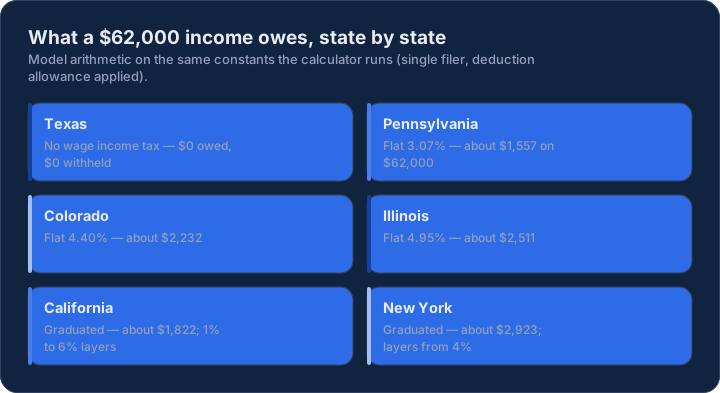
A state refund is the same equation as the federal one, just with different constants: state tax withheld from your paychecks, minus the state income tax your annual return computes. The complication is that every state writes its own tax code. Most states start from federal-style taxable income, but each sets its own brackets or flat rate, its own standard deduction (some match the federal one, many are smaller or absent), and its own credit catalog — which is why a $62,000 earner owes one flat 3.07% multiplication in Pennsylvania and a layered stack reaching 6% in California. This calculator uses each state’s published rate for flat states and published bracket layers for graduated ones, with a deduction allowance scaled to your filing status — close enough to plan with, honestly labeled as an estimate.
The nine states that levy no wage income tax
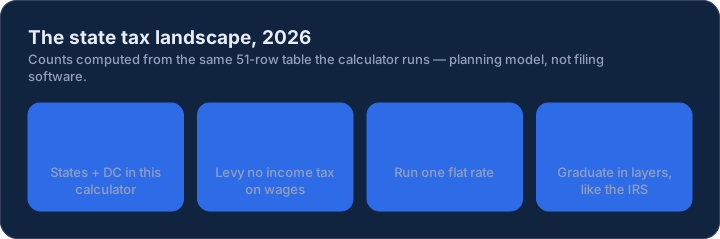
Alaska, Florida, Nevada, New Hampshire, South Dakota, Tennessee, Texas, Washington and Wyoming collect no income tax on wages in 2026. Live and work in one of them and this calculator shows a flat zero — there is no state income tax to refund. Two footnotes keep it honest: Washington does levy its separate tax on high capital gains (wages are untouched), and if your W-2 shows state income tax withheld while you work in a no-tax state, that is almost always an employer records error — the fix is a corrected W-4 with your employer, not a refund application. Remote workers take note: withholding generally follows your work state, not your employer’s address.
Flat tax states versus graduated ones
The state landscape splits three ways in 2026. Nine states tax wages at zero. Nineteen run a single flat rate on income — Pennsylvania at 3.07%, Arizona at 2.5%, Indiana at 2.9%, Colorado at 4.4%, Illinois at 4.95%, Massachusetts at 5%, Michigan at 4.25% — where the math is one multiplication. The remaining twenty-three graduate like the federal system: California reaches 9.3% in this model at high incomes, New York’s layers reach 6.25% on a $150,000 income, New Jersey 5.675%, Minnesota 7.5%. The full 51-row reference table below shows every state’s structure — the same table the engine runs, so you can audit any row the calculator produces.
A worked example: $62,000 in California vs Texas
Take a single filer with $62,000 of wages. In California, the model allows $11,270 for the deduction, leaving $50,730 of state taxable income; the layers — 1% to $10,756, 4% to $44,937, 6% above — produce about $1,822 of state tax. If the year’s paychecks withheld $2,200, the return shows a $378 state refund. In Texas the same income owes $0 and should have withheld $0, so the state line is simply empty. Same person, same effort, two completely different state outcomes — and neither number changes the federal result, which is why the combined view on the refund calculator keeps the two tiers in separate rows.
Why your real state return can differ
Three legitimate gaps between this estimate and the return you eventually file. Local income taxes — New York City, Yonkers, Ohio municipalities, most Pennsylvania localities — stack on top of state tax and are too jurisdiction-specific for any state dropdown. State credit catalogs — state Earned Income Tax Credit versions, property tax circuit breakers, renter rebates — move the number, sometimes substantially for lower incomes. And itemizing rules differ: a few states force itemized deductions if you itemized federally, others decouple entirely. If your state refund lands far from this estimate, the gap is almost always in one of those three buckets — not an arithmetic error.
| State | Structure | Rate / top rate |
|---|---|---|
| Alabama | Graduated | to 5.00% |
| Alaska | No income tax on wages | $0 |
| Arizona | Flat | 2.50% |
| Arkansas | Graduated | to 3.90% |
| California | Graduated | to 9.30% |
| Colorado | Flat | 4.40% |
| Connecticut | Graduated | to 6.50% |
| Delaware | Graduated | to 6.60% |
| District of Columbia | Graduated | to 8.95% |
| Florida | No income tax on wages | $0 |
| Georgia | Flat | 5.19% |
| Hawaii | Graduated | to 7.60% |
| Idaho | Flat | 5.30% |
| Illinois | Flat | 4.95% |
| Indiana | Flat | 2.90% |
| Iowa | Flat | 3.80% |
| Kansas | Graduated | to 5.70% |
| Kentucky | Flat | 3.50% |
| Louisiana | Flat | 3.00% |
| Maine | Graduated | to 7.15% |
| Maryland | Graduated | to 4.75% |
| Massachusetts | Flat | 5.00% |
| Michigan | Flat | 4.25% |
| Minnesota | Graduated | to 7.50% |
| Mississippi | Flat | 4.40% |
| Missouri | Graduated | to 4.70% |
| Montana | Graduated | to 5.90% |
| Nebraska | Graduated | to 5.20% |
| Nevada | No income tax on wages | $0 |
| New Hampshire | No income tax on wages | $0 |
| New Jersey | Graduated | to 5.67% |
| New Mexico | Graduated | to 4.90% |
| New York | Graduated | to 6.25% |
| North Carolina | Flat | 4.25% |
| North Dakota | Flat | 1.95% |
| Ohio | Graduated | to 3.50% |
| Oklahoma | Graduated | to 4.75% |
| Oregon | Graduated | to 8.75% |
| Pennsylvania | Flat | 3.07% |
| Rhode Island | Graduated | to 5.99% |
| South Carolina | Flat | 3.20% |
| South Dakota | No income tax on wages | $0 |
| Tennessee | No income tax on wages | $0 |
| Texas | No income tax on wages | $0 |
| Utah | Flat | 4.55% |
| Vermont | Graduated | to 7.60% |
| Virginia | Flat | 5.75% |
| Washington | No income tax on wages | $0 |
| West Virginia | Flat | 3.54% |
| Wisconsin | Graduated | to 7.65% |
| Wyoming | No income tax on wages | $0 |
Estimates for planning only — not tax, legal or accounting advice. Your actual return depends on facts this tool does not ask about. Figures are based on IRS Revenue Procedure 2025-32 (tax year 2026), verified October 2026.