
What a refund advance actually is
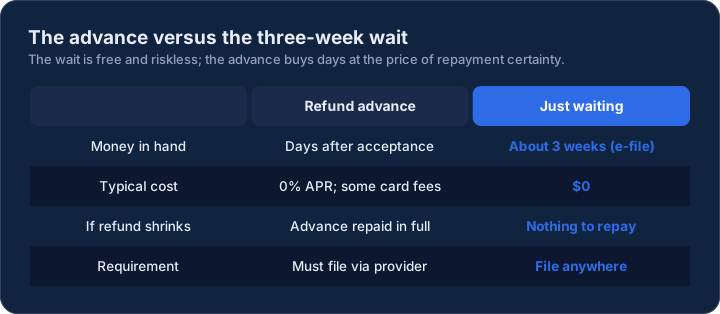
A tax refund advance is a short-term loan secured against your expected refund, offered at e-file time by tax software providers and tax preparation chains — TurboTax, H&R Block and Jackson Hewitt have all run prominent programs in recent seasons. You file through the provider, the IRS accepts your return, and the provider fronts you a portion of the expected refund — recent seasons have ranged from a few hundred dollars to roughly $4,000, with each provider setting its own limit every season. When the IRS sends your refund, it goes to the provider first: they subtract the advance, and the remainder lands with you. The product has a legitimate core — it converts a three-week government pipeline into days — and a fine print layer that deserves a full read before you tap accept.
How the mechanics work, end to end
The sequence runs through five stations. You e-file through the provider and opt in. The IRS acknowledges the return — usually within a day for e-file, and most providers release advance money within hours to a couple of days of acceptance. The advance lands on a prepaid card or account the provider sets up. The IRS finishes processing and sends the full refund to that same account. The provider recoups the advance automatically and releases the balance. The clock that matters most is step two: if your return trips a review flag, the EITC mid-February hold applies, or the IRS simply queues you longer, your advance sits there with the same wait everyone else has — the advance buys speed only when the pipeline itself is fast.
The cost question: 0% APR is not automatically free
Headline programs advertise 0% APR and no upfront fees, and many runs of these products genuinely charge nothing — the provider profits from your filing fee instead. But the fine print varies in three places worth checking before opting in. Some programs tier the "free" advance by product level, dangling the no-fee version over the paid tiers. Prepaid cards attached to advances can carry out-of-network ATM fees, monthly inactivity fees or reload fees that nibble the edge off. And a minority of products in the market are refund-anticipation checks or transfer products with real fees — a different beast that uses similar language. The honest test: ask what total comes out of your refund besides the advance itself. Anything above zero deserves a second look.
The repayment risk nobody reads until it happens
The advance is repaid in full from your refund, whatever your refund turns out to be. If the IRS adjusts your return — a credit disallowed, a document mismatch, an offset for a past-due debt — your refund can come back smaller than the advance you already spent. The provider then collects the shortfall from the balance, and if the balance cannot cover it, you owe the difference directly, under the loan terms you accepted. The same exposure applies to delays: an advance taken January 30 against a refund held to late February for the EITC rule is six weeks of borrowed patience. The defensive habit is simple — take no more than you could comfortably repay from a refund one size smaller than estimated, and treat the refund calculator estimate as the ceiling, not the floor.
When an advance makes sense — and the free alternative
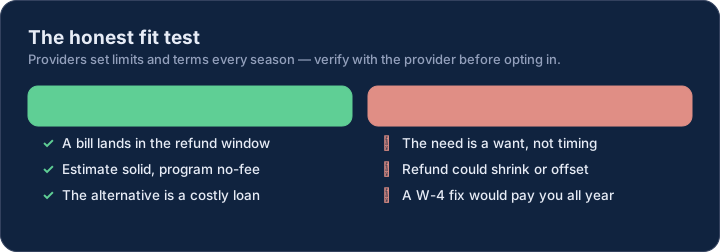
The clean case for an advance: an unavoidable bill lands in the refund window, you have a high-confidence refund estimate, the program is genuinely no-fee, and you would otherwise reach for a far more expensive credit product. The clean case against: your need is a want, not a timing problem — and waiting three weeks is the highest-yield financial move available in January. The free alternative that beats both: stop lending the government the money all year. The W-4 withholding calculator shows the per-paycheck adjustment that turns next year’s refund into monthly take-home — money in hand all twelve months, no provider, no repayment risk. And when you do file, e-file plus direct deposit is the fastest free pipeline; the timing mechanics are on the 2026 refund schedule.
Estimates for planning only — not tax, legal or accounting advice. Your actual return depends on facts this tool does not ask about. Figures are based on IRS Revenue Procedure 2025-32 (tax year 2026), verified October 2026.