
The 2026 filing calendar at a glance
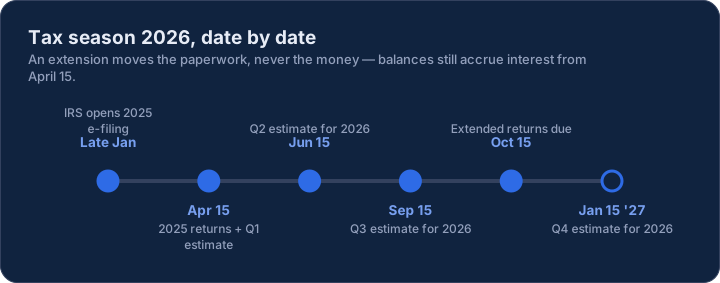
The season for filing 2025 returns opens in late January 2026 (the IRS confirms the exact date each January — e-file goes live, refunds begin flowing within 21 days for clean returns). The big date is Wednesday, April 15, 2026: federal returns and first-quarter 2026 estimates are due the same day. File Form 4868 by that date and you get an automatic extension to October 15, 2026 — but an extension extends the paperwork, not the money: any balance due still accrues interest from April 15, and if you also failed to hit a safe harbor, the failure-to-pay penalty (0.5% of the balance per month) starts the day after the deadline. Requesting the extension while underpaying is the most common expensive misunderstanding in the calendar.
The four estimated-tax dates for 2026 income
If you earn income with no withholding — freelance, gig, rents, heavy interest — 2026 has four deadlines: April 15, June 15, September 15, 2026 and January 15, 2027. The quarters are deliberately uneven (four months, two, three, three-and-a-half) and each payment covers the income earned in the period that just closed. Penalty math is per-quarter: an unpaid Q1 gap accrues penalty from April 16 even if you pay everything by September. Two outs: the 90% current-year safe harbor and the 100%-of-last-year safe harbor (110% above $150,000 AGI) — hitting either through withholding-plus-estimates makes the penalty $0. The quarterly calculator splits your projected obligation across all four dates.
Refund timing and the December tax-law lag
E-filed 2025 returns with direct deposit typically refund within 21 days of IRS acceptance; paper returns run six weeks or more. Three structural delays to know: returns claiming the Earned Income Tax Credit or Additional Child Tax Credit are held by law until mid-February no matter how early you file; returns filed before the season officially opens sit in a queue until systems go live; and if a new tax law passes late in the year before the season (as OBBBA did), the IRS publishes revised forms and guidance in December-January, and early-season refunds for affected credits can run a few weeks slow. Plan cash flow around the 21-day median, not the "file today, paid tomorrow" marketing.
The penalty table nobody reads until it is too late
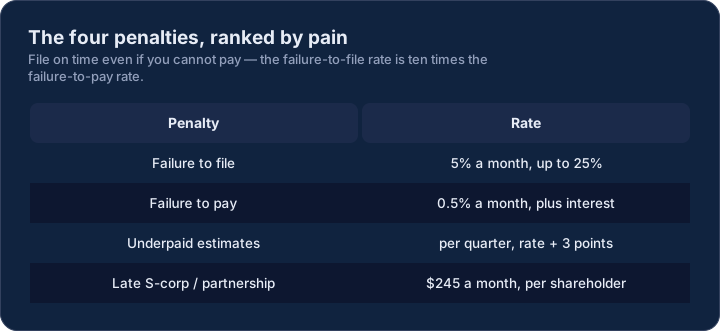
Four penalties carry the season. Failure to file: 5% of the unpaid balance per month up to 25% — the single most expensive rate in the code, and it applies even if you cannot pay (file anyway). Failure to pay: 0.5% per month on the balance, plus interest at the federal short-term rate plus three points, compounded daily (2026 rate: roughly 7-8% annualized). Underpayment of estimates: computed per-quarter on the gap below the safe harbor, same rate-plus-three formula. Late S-corp/partnership filings: a flat $245 per month per shareholder — no income required. The asymmetry worth internalizing: the failure-to-file rate is ten times the failure-to-pay rate, so when money is tight, file on time, pay what you can, and set up an installment agreement online for the rest — the penalty math rewards that order unambiguously.
Dates after the season: amending, audits and records
The calendar does not end April 15. You have three years from the original deadline to file for a refund you missed (the 2022 refund window, for stragglers, closes April 15, 2026) and three years to amend a return — seven years to amend for bad-debt or worthless-security claims. Audit notices arrive by mail (never by phone or email) usually within two years of filing; keep returns and support documents for at least three years, seven if you claimed losses. And the 2026-season dates that matter for next year: the SSA announces the 2027 wage base with the October 2026 COLA, and the IRS publishes the 2027 inflation-adjustment tables (Rev. Proc.) in late October or early November 2026 — the moment this site’s calculators roll forward. Bookmark the timeline; the year has a rhythm.
Estimates for planning only — not tax, legal or accounting advice. Your actual return depends on facts this tool does not ask about. Figures are based on IRS Revenue Procedure 2025-32 (tax year 2026), verified October 2026.