
A refund is just arithmetic: paid minus owed
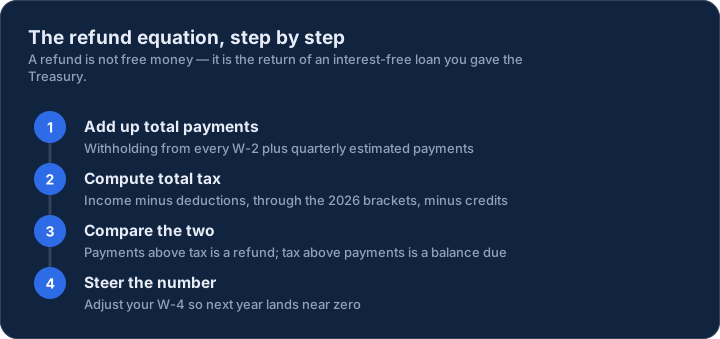
Every refund is the same equation — total payments minus total tax. Payments are the withholding from every W-2 plus any quarterly estimated payments you made. Total tax comes from the same engine as the income tax calculator: income, minus the standard or itemized deduction, through the 2026 brackets, minus credits. When payments exceed tax you get a refund; when they fall short you owe. Nothing about a refund is "free money" — it is the return of an interest-free loan you gave the Treasury through your paychecks.
Why the average refund keeps growing
The average federal refund has hovered near $3,000 for years, and two 2026 rules push withholding-sized refunds higher for specific groups. Workers with substantial tips or overtime now get an above-the-line deduction (up to $25,000 for tips) that lowers the tax owed while their employers still withhold as if it were fully taxable — the gap comes back at filing. The same mechanism applies to the senior bonus deduction for 65+ filers whose Social Security and pension withholding does not know about it. If either describes you, expect a bigger refund and plan for it rather than treating it as a windfall.
The refundable-credit floor
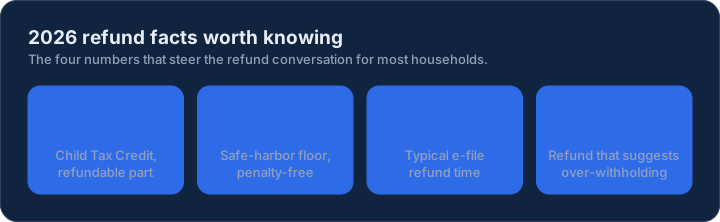
Two credits can push a refund even when you owed little or nothing. The Child Tax Credit is refundable up to $1,700 per child in 2026 — a family with $2,200 credits and only $900 of tax still receives the $800 difference in cash. The Child and Dependent Care Credit can similarly exceed liability for low-income filers. This is why households earning modest incomes with children can lawfully receive refunds larger than everything withheld: part of the payment is a government benefit delivered through the tax return, not a return of overpaid tax.
The state half of your refund
Most states run a parallel version of the same equation: state tax withheld from your paychecks minus the state income tax your return computes. Pick your state above and the calculator adds that layer — state taxable income estimated from your annual income, state tax from that state’s published rates, refund or balance due from what your pay stubs actually withheld. Nine states levy no income tax on wages at all — Alaska, Florida, Nevada, New Hampshire, South Dakota, Tennessee, Texas, Washington and Wyoming — so there is no state tier to add and any state income tax on their pay stubs is a red flag, not a refund in waiting. Want the state number on its own, without the federal engine? The dedicated state tax refund calculator runs just that layer, state by state.
What a state refund is not
A state refund is not extra money — it is the return of state tax you overpaid, and if you itemized deductions on last year’s federal return and deducted state income tax, part of it may even be taxable income on this year’s federal return — the flip side of having claimed that deduction. The estimate above uses published rates and a deduction allowance rather than each state’s full credit catalog — state EITC versions, property tax rebates and renter credits can move the real number either way. Treat the state figure as a planning band: usually within a couple hundred dollars for typical W-2 households, with the honest exceptions called out on the page itself.
Owing is not a crisis — underpaying can be
A balance due of a few hundred dollars is normal, especially with side income that had no withholding. The line to respect is the safe-harbor rule: owe no more than $1,000 beyond withholding, or pay at least 90% of this year’s tax (110% if your income is over $150,000), and the IRS adds no penalty — just interest-free use of your own money until the April due date. Cross that line and the underpayment penalty runs at the federal short-term rate plus three points, which in 2026 means real money on a real gap. The fix is a W-4 adjustment or quarterly payments, both of which this site has dedicated tools for.
Steering next year’s number on purpose
Run this calculator with your expected 2026 income and your current withholding trajectory. If the result shows a refund above roughly $2,500, you are over-withholding — filing a new W-4 to claim dependents or reduce withholding converts that refund into monthly take-home, which is worth more than the zero interest the Treasury pays on it. If it shows a balance due above the safe harbor, add an extra dollar amount to line 4(c) of the W-4 sized to the gap divided by remaining pay periods. Either adjustment takes one payroll cycle to take effect, which is why the best month to fix withholding is always this one.
Estimates for planning only — not tax, legal or accounting advice. Your actual return depends on facts this tool does not ask about. Figures are based on IRS Revenue Procedure 2025-32 (tax year 2026), verified October 2026.