
| Your situation | Where to check | Available after |
|---|---|---|
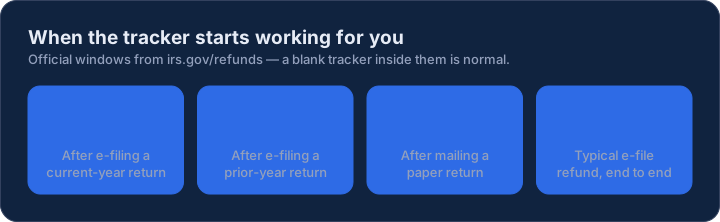
| Current-year return, e-filed | IRS refund tracker (irs.gov/refunds) | 24 hours after e-file acceptance |
| Prior-year return, e-filed | IRS refund tracker | 3 days after e-filing |
| Paper return | IRS refund tracker | About 4 weeks after mailing |
| Amended return | Where’s My Amended Return tool | Up to 3 weeks after filing |
| State refund | Your state revenue agency’s tracker | Varies by state |
The tool is free, official and needs no account
The IRS refund tracker lives at irs.gov/refunds and works without signing in for anything: you supply your Social Security number or ITIN, your filing status, your tax year and the exact refund amount from your return, and it shows where your money is. Checking it costs nothing, can be repeated as often as you like, and has no effect on processing — despite the folk belief that looking slows the machine down. The one discipline that matters: enter the refund amount exactly as printed on your return, to the dollar. The tool matches on it, and a rounded guess is the most common reason people get a "no record found" answer for a return that is sitting in the queue just fine.
The three panels, in the order they light up
The tracker reports one of three statuses, and each means something specific. Return Received means the IRS has your return and has not finished processing it — nothing is wrong, it is simply in the queue. Refund Approved means processing is done and the IRS has scheduled your refund — this is the moment the payment date becomes real. Refund Sent means the money has left the Treasury: direct deposits typically post to your bank within about five business days of that status (banks, not the IRS, control posting time), and paper checks mail out. Statuses update once a day, usually overnight — checking at 9 a.m. and 9 p.m. will show the same answer, so once a day is genuinely enough.

The timelines behind each step
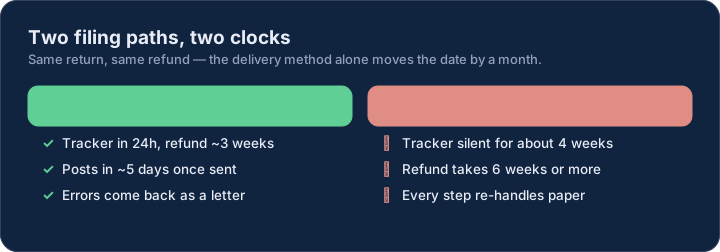
Plan around three official numbers. E-filed returns are typically refunded within about three weeks of acceptance when there are no issues — the bulk of that time is queue, not work. Paper returns take six weeks or more from the date the IRS receives them, which is why paper filing in April reads as slow motion. And the tracker itself stays quiet at the start: available 24 hours after you e-file a current-year return, three days for a prior-year e-file, and about four weeks for a paper return. The tracker showing nothing during those windows is normal, not a lost return. The full season calendar, including the 2027 season opening pattern, is on the 2026 refund schedule page.
Why refunds sit in review — and the mid-February law
Two deliberate slowdowns catch filers every year. Returns with errors — math mistakes, missing signatures, names that do not match Social Security records — get pulled for correction, which adds weeks and usually triggers an IRS letter rather than a silent delay. And by law, the IRS cannot issue refunds before mid-February for returns claiming the Earned Income Tax Credit or the Additional Child Tax Credit, regardless of when you filed in January: the hold exists to give fraud detection time to run, and every affected return releases together. If your EITC return was accepted in late January, a tracker stuck on Return Received through mid-February is the law working, not your return failing.
Amended returns, offsets and lost checks
Amended returns run on a separate track: the Where’s My Amended Return tool (or the automated line 866-464-2050) follows them, and processing routinely takes up to 16 weeks because the IRS must compare both versions line by line. If your refund is smaller than expected, it may have been reduced by the Treasury Offset Program for certain past-due federal or state debts — the offset notice arrives by mail after the fact. And if a paper check goes missing, the IRS reissues: call 800-829-1954 (single or head of household, current year) or 800-829-1040 for joint returns, or file Form 3911; expect the replacement check within about four weeks of the reissue date. Your refund is not statute-barred either — you have three years from the deadline to claim a refund you were owed.
Estimates for planning only — not tax, legal or accounting advice. Your actual return depends on facts this tool does not ask about. Figures are based on IRS Revenue Procedure 2025-32 (tax year 2026), verified October 2026.